Monday, June 8, 2015

Hatching Chicks...A Study of Animal Traits

During the month of May, third graders in room 177 learned about traits of animals.  To help us delve deeply into this exploration, we hatched chicks.  In lieu of a lengthy blog post on this topic, I opted to put together a movie slide show (the first I've ever made)  so that you could see first-hand some of the amazing things that the students experienced in our classroom.

On May 4, Ms. A. drove to Cincinnati to the Mt. Healthy Hatchery to pick up three Buff Orpington eggs whose chicks that had already begun to peck through the shell.  She placed them in an incubator that was plugged into an outlet in her car and drove them back to HSA-DE.  From there, the incubator was placed under the document camera and the image of the incubator was projected on the STAR Board during the day.  Students were given the opportunity to come up to the incubator for a close up view as well.

During the school day, the chicks worked to peck through the shell.  Ever so often, we would see a little bit of activity and then there would be long periods of stillness while the chicks rested.  Hatching is a tiring job!  Students would begin to get very excited when they could hear the chicks chirping!

Unfortunately, none of the chicks had hatched as of 2:15 p.m.  But right at dismissal time, one of the eggs began to really shake, rattle, and roll!  Students were glued to the screen of the STAR Board.  As busses were called, students from other grades filtered into our classroom to see this miracle of life happening right before our eyes.  Approximately 20 students from grades 2-5 sat with baited breath as we watched and waited for the baby chick to hatch.


This was the only chick to hatch while we watched.  By the time Ms. A. arrived at school the following morning, the remaining two chicks had hatched.

Please enjoy the following movie/ slide-show of the development of our classroom chicks.


Friday, June 5, 2015

Fourth Quarter Honors

The fourth quarter of the 2014-15 school year is behind us and with that Horizon Science Academy took some time to recognize students who demonstrated outstanding achievement in academics, character, and citizenship. The following students from third grade were recognized at the fourth quarter awards assembly in May.

Merit Roll


Merit roll is achieved when a student earns an overall GPA between 3.0 and 3.49.  The following third graders achieved the Merit Roll for the fourth quarter of this school year:

Kaylin
Shy'Diamond
Adriana
Abubakr
Alivia
D'Aijah
Marion

Honor Roll


Honor Roll is achieved when a student earns a GPA between 3.5 and 3.99.   The following students achieved Honor Roll during the fourth quarter:

Khadijah
Cayla
Diamond
Darren
TaMya
Da'Marieon

Super Honor Roll

Super Honor Roll is achieved when a student obtains a GPA of a perfect 4.0,  The following students achieved Super Honor Roll during the fourth quarter:

Ray'Von
Jayda
Angel
James

Special Honors and Awards

Highest Average in Science


Kaylin

P.E.

Marcus
D'Aijah


D'Aijah (Marcus, not pictured)


Highest Average in Reading

Cayla
Ray'von
Jayda
Angel
James

Ray'Von, Jayda, Cayla, Angel


Highest Average in Math

James
Angel
Ray'Von

Model Student

Khadijah
Cayla
Diamond
Jayda
Diamond, Jayda, Cayla, Khadijah


Most Improved

Reading: D'Aijah
Math:  D'Aijah
Science:  Ra'Jhay
Social Studies: Ra'Jhay
Behavior:  Ra'Jhay, Adriana, Alivia
Overall:  Cayla

D'Aijah, Ra'Jhay, Cayla, and Alivia


Horizon P.R.I.D.E. Award

Cayla

Citizenship

Cayla
Diamond
Jayda
Angel

Back Row:  Cayla, Diamond
Front Row:  Angel, Jayda


Multiplication Masters

Shy'Diamond
Lavon
Ray'Von
Jayda
Diamond
Marcus
D'Aijah
Angel
TaMya
Da'Marieon
James


Tuesday, June 2, 2015

Games to Help Your Child Practice Math Facts This Summer

Summertime can be a time of great fun for children.  But, if your children are like my children, it won't be long before you hear these words, "Mom, I'm bored!"  This is when you have a great opportunity to take things you may already have around the house and use them in a different way AND help your child be prepared for that first day of school in the fall.  Here are a few simple games that can be played with a partner or a small group.  They are fun and I bet your child won't even feel like he or she is studying!

Domino Games

Domino Keepers Addition

  • a game for 2 players (or two teams)
  • All of the dominoes are placed in the centre face down.
  • Both players pick up a domino at the same time.
  • Each player tells the sum of the dots on their domino, e.g. 2+4=6, 5+3=8.
  • The player with the highest answer keeps both dominoes. If both players have the same answer, each keeps a domino. The winner is the player or team with the most dominoes when all dominoes have been picked up.

Domino Keepers Multiplication

  • a game for 2 players (or two teams)
  • Play this game as above but instead of adding the two numbers on the domino, multiply them.
  • These games tick all of the boxes - the kids love them, they are simple to play and all you need is a set of dominoes!
 

Card Games

Addition/ Subtraction War

Like in the regular game of War, you are trying to get all the cards by having the highest card value. But in addition war you have two piles and flip over two cards at the same time. You must add your cards together to see if you have the highest value. To make it more challenging you could even have three piles and add three digits. This mental math practice makes computations a lot easier, even for adults.

Obviously subtraction war is played the same way, except you use subtraction to find the value of your cards. The great thing about using the speed cards is that you get to see the mathematical patterns that the 2’s cards make. Your children will start to notice that the patterns are different from the 3’s, 4’s cards etc.

Multiplication War

Like in the regular game of War, you are trying to get all the cards by having the highest card value. But in multiplication war you have two piles and flip over two cards at the same time. You must multiply your cards together to see if you have the highest product. This mental math practice makes computations a lot easier, even for adults.

Defensive Multiplication

Your child will become a multiplication genius with this exciting card game! Players strategize to earn points as they place playing cards on their handmade game board.


What You Need:
Deck of playing cards, face cards removed
4 sheets of paper
Tape
Pencil
Scratch paper
Black marker
2 Players, or 2 teams


What You Do:

  1. Have your child and her friends create a game board by drawing a 2 x 2 grid on each piece of paper. Tape the 4 sheets of paper together on the back and create a 4 x 4 grid.
  2. Announce that aces = 1.
  3. Ask one of the players to remove all of the face cards from the deck. Then divide the cards they removed into red and black cards. Each player gets either the red or black cards.
  4. The game consists of 5 rounds. A round of play is made up of 16 turns (8 for each player) and features a different target product. You can decide on whatever target products you'd like, but the target products we used are: 60, 72, 84, 90, and 96. These number have lots of factors so they're easier to work with.
  5. The two players must face each other. Players take turns placing any one of their cards into one of the spaces on the game board.
  6. Whoever completes a line of 4 cards in a row in any direction (including diagonally), successfully creating the target product, wins one point. An example of 84: 7 x 2 x 3 x 2 = 84.
  7. Once the board is full the round is complete. Clear the board and redistribute the cards back to the players before starting the next round.
  8. The player who has the most points at the end of 5 rounds wins!

Other Games

Egg Carton Shake-Up

Here’s a fun way for kids to practice their math facts & also reuse egg cartons!*

-To prepare the egg carton, simply number the bottom of each space 1-12.
-Pop two counters into the egg carton. (Marbles, Pom Poms, Dried Beans, etc. work great!)
-In pairs (or even groups of 3 or 4) or individually, take turns shaking the egg carton.
– They then place the egg carton right side up & open it to see where the counters ended up.
– On a sheet of paper record the numbers the counters are on, multiplying or adding (whichever you re practicing) them for their score.
– Add scores as they go.
– First player to 200 (or whatever number you set) is the winner!

*Remember to check for egg allergies in the class before using egg cartons.


Place Value Practice

This one can be done as a whole group or as a small group with a student acting as the number caller. Students set up a game board with dashes for each digit, plus a trash can. You can decide how many digits you want the number to be, depending on what your students are learning. In the above pictures, the game board was set up for a 3-digit number, plus the trash can. Teacher (or student) pulls one card from the deck, tells it to the class and each student must decide where to place the number on their game board, trying to end up with a number with the greatest value. Continue pulling cards one at a time and make sure that students place the number for each turn. Students can use the trash can to discard a number they don't want to use, but they can only use it once during each round. This game can also be done to create numbers with the least value and can be used for numbers with as many digits as you'd like.

I like this game because it requires skill and a bit of luck - any student can win. It can also reveal a lot - for instance when students are discarding eights and nines and placing ones in the hundreds place. Finally, I like it because it requires students to read their answer - reading large numbers can be a skill that students may not practice enough.

Wednesday, May 27, 2015

What's the MATTER? An Interdisciplinary Investigation about the States and Traits of Matter


Third grade students delved into another Physical Science discovery this Spring by exploring the traits and states of matter.

To kick off this unit, students began by observing three balloons.  Each balloon was filled with a substance that represented one of the three states of matter.

Three balloons:  The balloon on the left (pink) is filled with a gas, the balloon
in the middle (orange) is filled with a liquid, and the balloon on the right (white)
is filled with a solid.

Students observed each of the balloons and noted the traits each balloon had.  Students noted that the "white balloon" was not really a balloon at all.  I explained to the students that what had happened to that balloon was that while the balloon was in the freezer changing the state of matter of the water inside from a liquid to a solid, the balloon actually ruptured.  I explained that this happened because when a liquid freezes, it expands, or gets bigger, and that the balloon ruptured because the solid inside had gotten too big for the latex of the balloon to contain it.  I also explained to them that sometimes, some materials do not expand as easily when they are cold and that latex is one of them.  This is why the balloon would not get as big in the cold of the freezer as it would in the warmth of the classroom.  I told the students that I covered the solid that had taken the form of the balloon with the white so that they could have at least the visual of a balloon.

By discussing what we knew (prior knowledge) about each state of matter, students predicted what would happen when each balloon was popped and what shape the matter inside each balloon would take once the balloon was popped.  

Students predicted that they would not be able to see the gas.  Students predicted that the liquid would go everywhere inside the tray, and students predicted that they solid would stay the same.

Here is what happened:

The gas was invisible and could not be seen.  Students noted
that it went everywhere in the room.

The water filled the tray.  It took on shape of the tray
 instead of the shape of the balloon.

The solid stayed the same shape even when the balloon was
removed.


 After reading more about the states of matter students worked in P.R.I.D.E. groups to categorize which state a predetermined set of matter cards would be classified into.

Jayda, Lavon and Khadijah partner to categorize matter into the three states.

The next day, students created living models of the three states of matter so that we could demonstrate what happened to the molecules within each state or matter.  To do this, clear plastic trash bags and balloons were used.

Karissa, Marion, and Marcus pose as states of matter molecules.  Can you guess
which one is a solid, liquid and a gas?

Once the students were ready in their "costumes", they came into the classroom to model their molecule costumes.  Each student took a turn jumping around so that their classmates could see how the molecules (balloons) in their matter moved about.  Based on this observation, the observers in the class decided which molecule was a solid, which was a gas, and which was a liquid and then justified their opinion based on what they had learned thus far in this unit.


Marion represented a Liquid molecule.  His molecules moved about but stayed
close together.  Marcus represented gas.  His atoms moved about freely and did
not need to touch each other.  Karissa represented a solid.  Her molecules did not
move at all.

After this demonstration, students worked independently to complete an interactive notebook entry about the traits of matter.  A solid has a definite volume and a definite shape.  A liquid has a definite volume but its shape changes depending on the shape of the container.  A gas has no definite shape and no definite volume.

Darren displays his science sort interactive notebook
entry which explains the traits of the states of matter.


Next, we began to explore the gas state of matter a little bit more in depth.  We did this because it is such a difficult concept for students to understand because it is something we cannot see.  Students conducted to experiments specifically tailored to observing gas.

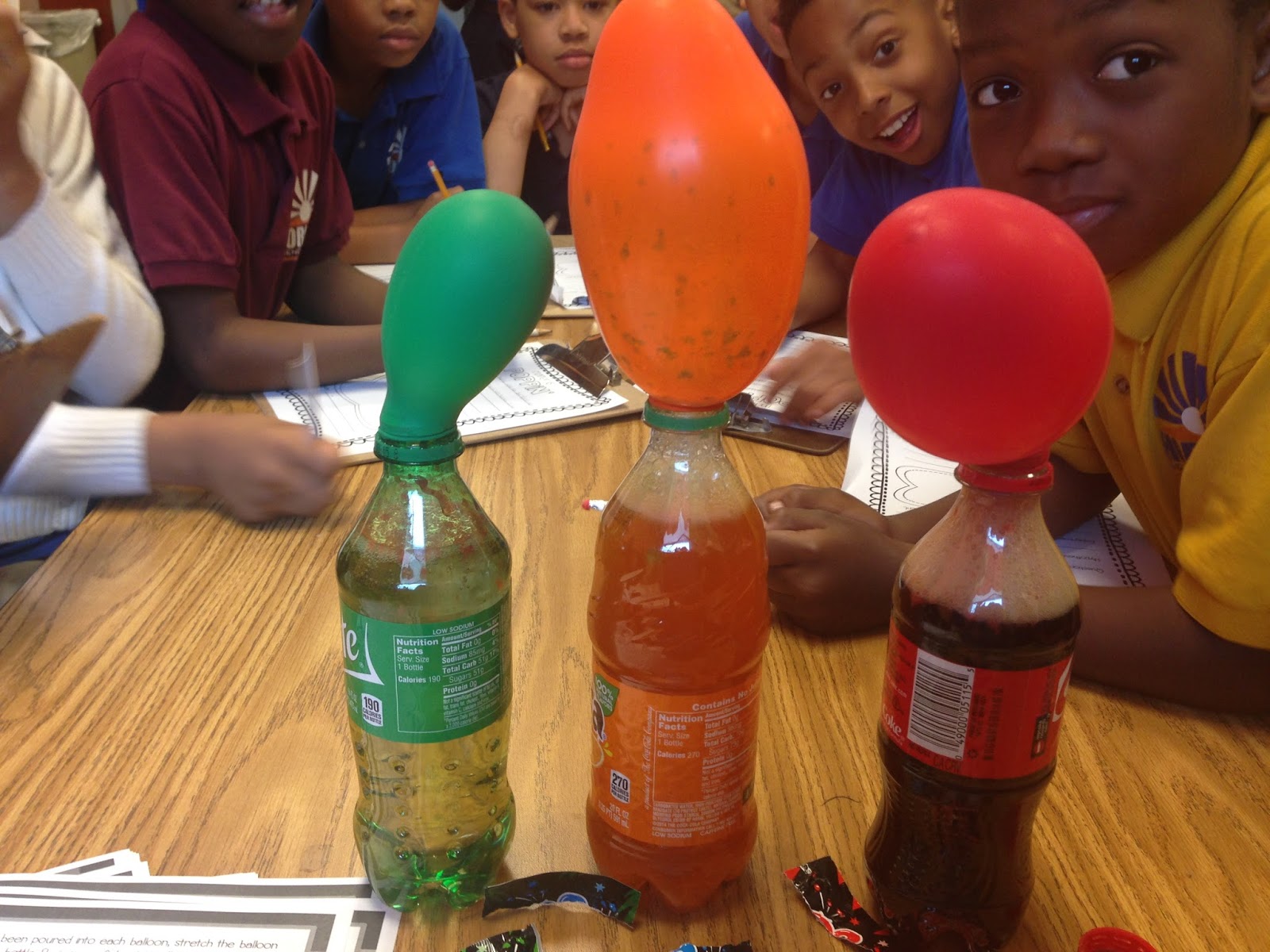
The first was an experiment called "Matter is a'Poppin'".  During this experiment, we used three different types of soda (Sprite, Fanta Orange, and Coke), balloons, and Pop Rocks candy.

The materials needed for the Matter is a'Poppin' science experiment.

Each student was given a clip board and a data sheet to record the steps of the scientific process for this experiment.  Students recorded the materials, and the procedure.  The procedure for this experiment, Pop Rocks would be placed inside the balloons.  Then, once the caps of the sodas were removed,  the balloons would be placed over the openings of each bottle. Finally, the Pop Rocks would be emptied from the balloons into the sodas.  Students would observe for a reaction to occur.

Pop Rocks have been placed in the balloons.  They are shaken down
into the "bulb" part of the balloon.  The opening of the balloon is placed over the
mouth of each bottle.  
Students then made hypotheses on their data sheets about what they predicted what would happen during the experiment.  Once they had their hypotheses recorded, we were ready to begin the experiment...

Pop Rocks have been shaken down into the sodas.  Students are observing
reactions.

Almost immediately, students notice the balloons expanding (getting bigger).  Students are seeing fizzing.  We discuss what that fizzing is and note that it is occurring because of a gas.  We are all wondering why some of the the balloons are getting bigger than others.


Now, we don't see any more fizz in the bottles.  We notice that the Fanta and Coke
balloons got much bigger than the Sprite.  We wonder why.

After the experiment is over, we have a discussion about possible reasons why the Fanta and Coke balloons got bigger than the Sprite balloon.  One reason we noted is that the Fanta bottle had more liquid volume than the Sprite and Coke bottles (20 oz bottle compared to 16 oz bottles).  Could it be that with more liquid there could have been more gas produced?  We also noted that the Fanta and the Coke both were colored beverages but the Sprite was a clear beverage.  Could it be that the Sprite produces less gas because it contains less chemicals to begin with?  We were left with many questions.

Following this experiment, students wrote lab reports to convey their learning.  Here are some pictures of their finished reports.

Marcus, RayVon, TaMya, and Kaylin's lab reports.

Da'Marieon's written lab report.

Da'Marieon's written lab report.

The second science experiment we did was a Gas Rocket.  To do this we needed a 2-liter bottle of Diet Coke and a roll of Mentos.  The entire package of Mentos was dropped into the 2-liter bottle of Diet Coke as third graders stood around to observe the reaction...the following took place:

The Mentos created a reaction inside the bottle that caused
gas to be formed.  The gas molecules moved out of their
container through the opening taking soda with them (fizz).

To conclude our study of the states of matter, we made root beer floats. 

Ymmmmm!  What a great way to study
the states of matter!
 Each component of the root beer float represented one of the states of matter.  The ice cream was a solid.  The root beer was a liquid.  But where was the gas?  You guessed it!  When the root beer was added to the ice cream, we saw the gas bubbles of the fizzing pop!


Here are three third graders reaction to having a root beer float as part of science class!

D'Aijah...I think she likes it...

Ra;Jhay...I think she likes it...

Looks like it's unanimous!  Abubakr likes it, too!

Tuesday, May 19, 2015

Life Cycle of a Citizen: A Study of Economics


During the third and fourth quarter, third grade students spent time learning about the role of economics in citizenship.  To learn more about  this, students listen to several children's books and then participated in interactive activities to enhance their understanding of economic concepts.  One such children's book was Saturday Sancocho by Leyla Torres.

In this lesson, students listen to a story and answer questions about a family in Central or South America that barters to get the ingredients for chicken sancocho, a kind of stew. The students complete sentences that record the various trades carried out by the family to obtain all of the ingredients for the sancocho.


They participate in a trading activity where they barter with each other to get the ingredients needed to make chicken sancocho and learn about the difficulties associated with barter. They use money in a second round of the trading activity to learn about money’s advantages over barter.

James and Angel practice bartering and trading for ingredients to make sancocho.

During this interdisciplinary unit, students also enjoyed listening to podcasts of the novel Lemonade Wars by Jaqueline Davies.  Listening to podcasts was chosen for this novel so that students could
 work on their listening comprehension skills.  Students were given a series of questions to complete as they listened to each chapter.  This novel was a perfect choice to read as we explored economics because it detailed the story of  Fourth-grader Evan Treski and is sister Jessie as they endeavored to become lemonade stand entrepreneurs.  Evan is people-smart. He’s good at talking with people, even grownups. His younger sister, Jessie, on the other hand, is math-smart, but not especially good with people. So when the siblings’ lemonade stand war begins, there really is no telling who will win—or even if their fight will ever end. Brimming with savvy marketing tips for making money at any business, definitions of business terms, charts, diagrams, and even math problems, this fresh, funny, emotionally charged novel subtly explores how arguments can escalate beyond anyone’s intent.

In order for students to further grasp the concepts of economic principals, students were also able to play Money Metropolis, a free online game.  Money Metropolis is an educational game hosted on Practical Money Skills. In the game students choose savings goals then navigate their way through a virtual town to earn money toward those goals. Some of the earning opportunities are more lucrative than others. And some earning opportunities are easier than others. As you might expect, the easier tasks are not as lucrative. Along the way they are presented with some opportunities to spend the money that they've earned, but spending at those opportunities sets students back on their progress toward their goals.

While students were busy reading and learning these important social studies topics, third graders were busy applying what they were learning to real life.  In our classroom, students acted as producers by planting tomato, bell pepper, and marigold seeds and grew them in classroom greenhouses.  Having learned about thermal energy, students were aware that these greenhouses created a perfect environment for our plants to grow and thrive.


Darren, Kaylin, and Angel work together to plant seeds.


Classroom greenhouses provide thermal energy for plants to grow.

Students observed the plants grow over the course of the next couple of months...


Finally, it was time to transplant the seedlings into pots.


Cayla displays her re-potted plant.


Darren and Ray'Von and transplant seedlings.


In the larger pots, students were able to watch the plants continue to grow and strengthen...


While reading Lemonade Wars, student's learned about how to determine prices for the good that they want to sell.  They also learned that donating profits to a charity is something that some business people do.  The third graders in room 177 agreed to hold a plant sale where each plant would be sold for $0.50 each.  The proceeds from this sale would be donated to Alex's Lemonade Stand (for Childhood Cancer) Foundation,


On May 16th, students from Horizon Science Academy Dayton Elementary gathered at school for a spring planting event.  Students worked together to plant a school garden.  On this day, the third graders also held their plant sale.

Angel, Jayda, Cayla, and Diamond (not pictured) sold plants at the plant sale.

When selling plants, the customers who purchase the product are the consumers.

Diamond helps a customer at the plant sale.

While the plant sale was going on, students also helped beautify the school grounds...


Mr. Mims guides the students with planting day lilies.


Jayda, Cayla, Angel and others help to plant the caterpillar garden.

The third grade was able to raise a total of $25.00 to donate to Alex's Lemonade Stand.  Through this project that was funded by a Kids in Need Foundation Grant that was awarded to Ms. Amstutz, students were able to experience first hand, the role of producers and consumers in a society and experience what it is like to work to manage a business.  Students understood how much time it took to develop a product and they understood that sometimes, you have so spend money to be able to make money.